




THE ROSE-TINTED MENAGERIE
4. THE INTERNATIONAL DOLPHIN DEALERS
4.1 The Secret Trade in Captive Dolphins
"One of the most typical – not to say reprehensible – examples of man's continued ignorance as regards the keeping of animals in captivity is the latest trend towards keeping cetacea in oceanaria or dolphinaria to train them, an activity which became fashionable in the 1940's. In essence this is no different from the old attempts to satisfy man's curiosity by means of performing animals in miserable travelling circuses or showmen with their pitiful dancing bear acts."
~ Professor Giorgio Pilleri ~
A strong and often mystical bond of friendship has existed between human and dolphin since the dawn of civilisation. In ancient Greece, the killing of a dolphin was regarded as a sacrilege against the gods to be punished with death. The human-dolphin empathy upon which this edict was based was rooted partly in spiritual intuition and an appreciation of the creature's profound intelligence and compassion. But it also reflected an uncanny recognition of biological kinship. Not only had Aristotle correctly classified them as mammals, but it was widely believed that these 'marine cousins' of humanity had once lived upon dry land, together with the earliest ancestors of man and woman. "Diviner than the dolphin is nothing yet created," the poet Oppian wrote in Halietica, 1800 years ago. "They exchanged the land for the sea and put on the form of fishes." In a similarly glowing tribute, the philosopher Plutarch declared that dolphins are the only creatures who seek friendship for purely altruistic reasons, without any thought of personal gain.
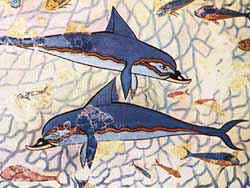 The civilisation’s luminous legends, frescoes and mosaics often depicted the animals rescuing shipwrecked sailors, or portrayed children riding on the backs of wild dolphins. But perhaps the greatest human homage to the dolphin is the legend surrounding the Delphic Oracle. Here, where the forces of the universe converged at the centre or navel of the Mother Earth, the benevolent dolphin god Apollo Delphinos became the interpreter between his father, Zeus, and a wayward humanity.
But while the ancient Greeks venerated the dolphin, the Romans simply butchered the animals and ate them. These extremes of relationship are much in evidence to this very day. Stories of dolphins befriending humans and playing with children, or saving bathers by fighting off shark attacks are still heard frequently, but they are usually eclipsed by distinctly macabre reports of dolphins being slaughtered by angry fishermen. A scapegoat for our own species' greed in fishing the oceans to exhaustion, in many parts of the world they are despised as "gangsters" or "thieves" because they damage nets and dare to eat fish that "belong" to human beings. For many years the governments of France, Greece and Japan even paid a bounty for the head of every dead dolphin that was brought in, simply because the animal was regarded as being in unfair competition with the fishing industry. Elsewhere, dolphins suffocate as they become trapped or entangled in fishing nets, or are maimed and mutilated by heavy machinery as the nets are winched on board. In the Eastern Tropical Pacific tuna fishing industry, which has claimed the lives of almost seven million dolphins since 1959, at least 125,000 individuals continue to be slaughtered every year with no justification apart from an all too respectable ambition to maximise profits.
Perhaps it would be logical to surmise from all of this that the ancient friendship between our respective species is no longer reciprocal. But that conclusion would be hotly disputed by the world's dolphinaria, who like to pretend that their dolphins have been rescued from a terrible fate in the wild. And indeed, judging by the numbers of dolphins in circuses, zoos and amusement parks around the world today, one might well assume that humanity's fascination for the intelligence, compassion and playful humour of these creatures has not diminished. But can this really be the same sincere and time-honoured friendship between distant cousins? Or is it the kitsch and cuddly illusion of Disneyland, a commercial dream-machine through which the dolphins are processed to feed an industry's dementedly-ringing cash-register and an insatiable human craving for distraction and entertainment; stripped of their natural identity, deprived of their own culture and environment, and subjected to a purgatory sometimes no less brutal than their slaughter in the wild?
The Secret Trade
The Swiss-owned International Dolphin Show (IDS), a 'postbox company' registered in Liechtenstein, is just one of many enterprises involved in the multi-million dollar industry of dolphin capture, sale and lease. The workings of this industry are shrouded in secrecy, partly because the exploitation of dolphins in circuses and amusement parks depends upon the public's belief that the animals are happy in their captivity. Despite a wealth of evidence to the contrary, this is an illusion carefully nurtured by the industry's public relations experts. Of the thirty-two species of dolphin scattered throughout the world's oceans, it is the Atlantic bottlenose, Tursiops truncatus, which is able to survive captivity the longest. But it must certainly be an added bonus to the owners that the bottlenose has that distinctive upward-curving mouth, giving an often deceptive impression to the public that the animal is smiling. The pain and misery, and the depressingly recurrent deaths of dolphins in captivity are systematically shielded from the public eye in order to preserve the vast profits spawned by that illusion.
The commercial competition in the international dolphin industry is intense, with the United States leading the world by providing 9000 full-time jobs and an annual budget estimated to be in the region of a third of a billion dollars. According to the American Association of Zoological Parks and Aquaria (AAZPA) there were 1135 marine mammals in captivity in the USA in 1975, and of these, 359 were cetacea. This relatively small number supposedly "provided educational displays" for over 130 million visitors or 114,537 visitors per animal per year. By 1983, that number had risen to 1341 sea mammals representing 27 different species.
Between 1938 and 1980, the USA took a minimum of 1500 live dolphins from the sea, and in the last ten years, Japan alone has captured 500 dolphins for various amusement parks. Altogether, it is speculated that at least 2,700 bottlenose dolphins have been taken worldwide, though according to the International Whaling Commission, 4500 small toothed whales are known to have been kept in captivity. These include 300 Pacific striped dolphins, 250 short-fined pilot whales, 150 spotted dolphins, 120 killer whales, 100 white whales, spinner dolphins, common dolphins, and finless porpoises, over 80 harbour porpoises, and limited numbers of at least another 20 species. But these statistics are grossly deceptive; they do not take into consideration the official apathy which reigned during the 1960's and 1970's when record-keeping was either inept or non-existent, nor do they even speculate on numerous illegal dolphin catching operations. More importantly, they do not take into account the slaughter which so often accompanies the dolphin catch. This "wastage" - as traders euphemistically refer to dolphins fatally maimed during capture - can sometimes exceed 50%, including pregnant mothers and nursing calfs. It is here, in the brutal capture of dolphins in the wild, that the industry's tacit conspiracy to beguile the public is most evident. The International Dolphin Show, for example, owned by the Swiss entrepreneur Bruno Lienhardt, has been specialising in the capture of dolphins for 18 years, mainly in Mexico, Guatemala and Taiwan. As we shall discover later, Lienhardt's catches off Taiwan's Penghu islands in 1980 resulted in the deaths of sixty dolphins, without so much as a murmur from the authorities or the dolphinarium-owners' lobbying organisation, the European Association of Aquatic Mammals. Similar catching operations are occurring regularly by enterprises in numerous countries, from Japan to Mexico, from Iceland to Thailand, the Philippines and Indonesia. It is merely the law of supply and demand, for as dolphins inevitably die off in their cramped pools, it is just as inevitable that they will have to be replaced.
Those dolphins that survive capture then have to undergo the terrifying ordeal of transportation which often claims more lives. The animals are usually transported in an aluminium or wooden crate, on an irrigated stretcher suspended with belts to give some protection to their vital organs which become all the more vulnerable once the animal is taken out of its natural weightless environment. This stretcher, when bound-up with tape, can also become a 'strait-jacket' for dolphins which are liable to panic, and Valium, a sedative, is often used in an attempt to calm the animals. Those that manage to survive transportation are then consigned to their new habitat, perhaps a zoo, dolphinarium, circus or travelling show. According to statistics provided by the UN's Food and Agricultural Organisation (FAO), dolphins in the wild can live up to 30 years, but their average life expectancy in captivity is a mere 5.3 years. Though longevity may have improved in some institutions over the years, conditions vary a great deal, with travelling shows offering such primitive facilities that the dolphins may live no longer than a season or two - but long enough for the owners to make a substantial profit on their investment.
"The Inherent Contradiction"
It was a 1983 report by cetacean specialist Professor Giorgio Pilleri, Director of the Brain Anatomy Institute of the University of Berne, Switzerland, which embroiled the world's dolphin industry in an international controversy. In Volume XV of his Investigations on Cetacea, Pilleri concluded: "Whatever efforts are deployed, the keeping of cetaceans in captivity will always pose problems because of the inherent contradiction on which it is based: the keeping in cramped conditions of creatures which are accustomed to vast open spaces." But Pilleri shies away from the unexpected attention which the publication of the report has brought him. A mild-mannered man in his sixties, Pilleri seems more like the archetypal absent-minded professor than someone intent upon stigmatising a lucrative international business. His twenty-year study of dolphin behaviour and intelligence - both in captivity and the wild - earned him worldwide respect in the scientific community, but he was soon to renounce both the vivisectionist methods which researchers often use to probe the mysteries of the dolphin mind, and the conditions in which the animals are held in captivity. "It is true that I kept dolphins here at the Institute," Professor Pilleri told me. "I feel ashamed at having done so. I feel ashamed for my lost dolphins. They were a rare river-living species from Pakistan, known as Platanista dolphins, unique in that they are almost blind and live in a totally turbid medium. They were nothing more than an alibi for scientific research since keeping dolphins in artificial conditions can do little else than produce artificial scientific results. Four of my dolphins died - three from skin disease caused by chlorine in the water and from consuming fish polluted with mercury and parasites, and one which died after breaking its beak." But although he feels anguish for the dolphins he lost, Pilleri is also adamant that his efforts eventually brought lasting protection for the river dolphins in Pakistan when a national park was established with the help of the World Wildlife Fund.
"Dolphins are usually netted by local fishermen," explains Pilleri, "who tend either to be poverty-stricken and in desperate need of some extra income or else they regard the dolphins as pests and are keen enough to be rid of them." However much care is taken, and whatever the precautions, he continues, deaths are almost inevitable. "I remember that in Assam when the fishermen tried to capture the Platanista river dolphins, on one occasion, all six died in the net, including three pregnant females. But for the industry this is by no means exceptional. After capture comes the ordeal of transportation, with the stress involved causing all manner of illnesses to break-out because stress has the effect of suppressing the immune system. Noise - especially high frequency - is very distressing to the animals. Many are likely to become sick or die during transport, particularly if the distances covered are great."
Dr Petra Deimer, a delegate on behalf of Germany to the International Whaling Commission, and an officially-appointed cetacean expert for the Scientific Authority of CITES, came to the same conclusion when investigating the capture of rare black and white Commerson or Jacobita dolphins found only in the waters of Patagonia. Between 1978 and 1983, she relates, 24 Cephalorhynchus commersoni were supposedly caught in Argentinean waters for dolphinaria abroad. Eleven of those were intended for Duisburg Zoo - though its director, Wolfgang Gewalt, claims the figure was only eight - and four destined for a dolphinarium in Japan. The fate of the nine missing dolphins was to become yet another enigma in the industry's long history of contempt for accountability, and Deimer speculates that they might well have died during capture. "Of the eleven - or eight - dolphins destined for Germany, only two males survived," she told me. "The 4 animals - one male and three females - intended for Japan never reached their destination. They were confiscated during a stopover in New York because of illegal importation into the USA - they had no permits. One female was already dead on arrival. The other three were brought to the Mystic Marinelife Aquarium in Mystic, Connecticut, where a second female died after 4 and a half hours. The male died after 8 days. The autopsy revealed pneumonia, gastro-enteritis, gastric ulcers and pancreatic fibrosis. The fourth animal - a female - suffered a chronic curvature of the spine she died in July 1981 because of 'multiple complications'." Prior to her death, the crippled animal was only able to swim with its flippers, and Deimer cites evidence to suggest that this was a result of the dolphin being injured in its shipping crate. She also notes that the male Commerson which had managed to survive for just eight days at Mystic, displayed typical captivity neurosis from the moment it was put in the pool: "Within minutes the male began to dash about erratically, hitting the walls of the tank, until it was treated with Diazepam," a sedative.
Dolphin circuses, like their counterparts under the big top, like to portray their animals as well-adjusted beings displaying nothing but the most natural of behaviour. But in reality, little could be more unnatural than a captive dolphin, if only because from the moment of capture, every single individual must be kept afloat by injections of synthetic vitamins, broad spectrum antibiotics, fungicides and hormones. Without them, they would live no longer than a few days, succumbing to infections and malignant parasites as stress ravages their natural immunity. Indeed, once captured and confined, most dolphins will never again escape their nightmare world of stress, insecurity and neurosis except through the merciful release of death. Apart from the devastating trauma of capture, there is the inherent stress of confinement itself, which reduces highly-evolved dolphin society into a primitive pecking order, with the stronger and more aggressive animals not only fighting each other for supremacy but also hounding the weaker ones into submission, illness or death. Besides the tyranny of their own companions, there is also the tyranny of the show-master, the stress of performing to the crowds five times a day, and rigorous training methods of food deprivation and reward which can only incite further stress and jealousy among the captives. Indeed, recent studies in the United States suggest that an inordinate number of captive dolphins are succumbing to typical stress-related illnesses such as heart attacks and gastric ulcers. It can hardly be sheer coincidence that virtually identical disorders affect millions of human beings forced to endure tedious and repetitive menial work.
Yet it is not only aggression that manifests itself with this extreme and artificially incited social hierarchy. According to some cetacean scientists, including Giorgio Pilleri, aggression may just be one symptom among many in a fundamental desocialisation of the animals, a mortifying indictment of dolphinarium culture since the Jekyll and Hyde character-change which can so often afflict the captive dolphin must, to some degree, reflect the human influence which provoked that metamorphosis. While in the wild the dolphins hunt co-operatively in schools, herding the fish and sharing, in captivity they have been observed to display acute selfishness, even sadism. In an oceanarium in Florida, for example, it was observed how several bottlenose dolphins persistently chased away one of their ailing companions to prevent it feeding, even going so far as to pull the fish out of the dolphin's mouth. This antisocial behaviour continued even after the 'thieves' had gorged themselves to excess. Such constant intimidation inevitably causes debilitating stress since the victim simply has nowhere to hide. Physical aggression has also been witnessed regularly between species held in close confinement, including instances of bottlenose dolphins attacking Risso's dolphins, spotted dolphins, common dolphins, pilot whales and pigmy sperm whales. Similarly, a false killer whale was reported to have set about and killed a young pilot whale, while at another establishment an Amazon river dolphin killed a smaller Amazon Sotalia. Sometimes, the much touted "natural behaviour" of unnaturally mixed species can be even more macabre. In one American oceanarium, a demented female dolphin was observed pushing her stillborn baby around the pool, perhaps out of some pitifully futile effort to breathe life into it. This compulsive grieving continued until a male pilot whale took the little corpse away from her, held it between its teeth for half an hour and then swallowed it.
Another much-neglected source of tension and anxiety which haunts the captive dolphin is incessant noise pollution, something which the animals are particularly susceptible to. From the constant racket of filtration pumps to the rhythmic booming of rock music, vibration and echoes are conducted so efficiently through the steel or concrete pool structures that dolphins may suffer almost permanent distress. By pretending that the problem isn't there, most dolphinaria hope that it will just go away. Petra Deimer reports that the respected Dr. Klaus Hagenbeck of Hamburg Zoo, following consultation with the world's pre-eminent dolphin vet David Taylor, came to the conclusion that "there are noises in the sea as well." But perhaps not the constant, inescapable drone that can evidently turn some animals insane. The reasons for this extreme sensitivity become more apparent when one realises that the dolphins live more by sound than any other faculty. Scientific experiments over the years have revealed that the dolphins' ability to "see" underwater utilising high-frequency sound is so advanced that it is at least ten times more effective than any sonar system yet devised by the U.S. military. Some researchers also believe that the dolphins' use of sound might enable them to look into the minds of their companions, to detect emotions and even thoughts. Dolphin communication, writes Carl Sagan in The Dragons of Eden, may involve "a re-creation of the sonar reflection characteristics of the objects being described. In this view a dolphin does not 'say' a single word for shark, but rather transmits a set of clicks corresponding to the audio reflection spectrum it would obtain on irradiating a shark with sound waves in the dolphin's sonar mode. The basic form of dolphin/dolphin communication in this view would be a sort of aural onomatopoeia, a drawing of audio frequency pictures - in this case caricatures of a shark. We could well imagine the extension of such a language from concrete to abstract ideas…" As we shall discover later, this sophisticated natural sonar system is one reason why both the American and Russian navies have invested heavily in dolphin research, though the animals have proved their worth to military minds not only in the improvement of radar and sonar they have also been 'trained' as "living torpedoes".
Other hazards that the captive animal must face include ingesting toxic paint applied to the pool liner, as well as an astounding variety of foreign objects apparently tossed frequently into the pool by visitors, from camera cases to gloves. At the shallow "Petting Pool" of Florida's Sea World, visitors both young and old are actually encouraged to feed dolphins with fish purchased at a nearby kiosk. Being confined to the pool, and unable to escape the attentions of the clamorous human visitors, the dolphins soon become consumed by boredom and relapse into expedient begging behaviour. Yet in the stomachs of the animals, not only fish is found, but also coins, hats and tennis balls, the kind of objects that regularly prove fatal to dolphins in oceanaria all over the world.